The Eleventh Hour
A Reflection on Matthew 20:1-16
Before dawn the men are already standing. In my own city, Nazareth, I can still see them: the West Bank Palestinian labourers who gathered at one corner early in the morning, waiting to be chosen for a day’s odd work. They came with nothing to offer except their bodies and the hours of the day ahead of them. They stood, and they waited, and they watched the road for the one who might slow down and pick them, because to be chosen was to eat that night, and to stand unchosen was to carry the hunger home. This is among the oldest pictures of vulnerability there is, and it is ours. It is the picture with which Jesus opens his parable of the reign of heaven.
A landowner, literally translated as the “master of the house” or “householder,” goes out at first light and agrees with the earliest workers on a denarion for the day, and sends them into his vineyard. He goes out again at nine, at midday, at three. The working day held twelve hours, from sunrise to the dark, so when he goes out once more at the eleventh hour, with only one hour of light remaining, he finds people still standing there.
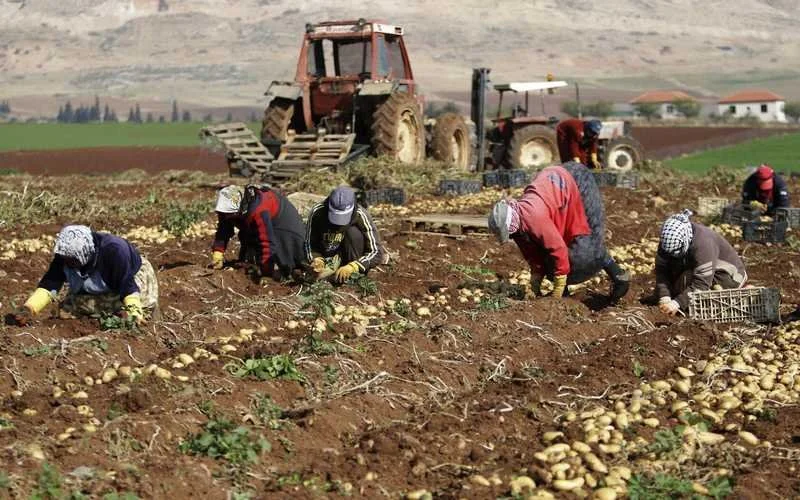
Image Taken from Progressive International article (click image to read full article)
Let us assume the all-day workers have a point. In the economy most of us live within, their complaint is plain math: more hours should mean more coin, and equal pay for the unequal time reads as theft of the difference. Their measure of worth runs sideways. They look along the line to the worker beside them and weigh themselves against him. The householder measures on a different axis all together. This denarion is a day’s bread, the amount a household needs to eat for one day, and the one-hour worker has a family who will be hungry tonight for the same reason the first worker’s family will be hungry. The first workers ask to be paid by what each has earned, which would send some home away empty. The householder pays by what each household needs, which fills them all. The reign of God, then, is measured by one simple thing, whether the people eat. And if that is the measure, we are made to ask its opposite. What do we name a power that makes people hungry, that keeps the bread from them on purpose?
Hear what the householder says to the one who grumbles. He offers no defence of his generosity. He names instead the thing the worker left unspoken, asking whether their eye is evil because he is good. The evil eye, the eye that resents a neighbour’s undeserved blessing, an old word in our scripture and a living word in our streets, عين الحسود. Beneath the math lies envy, the ache of watching another eat bread they did not earn.
Now hear where the land speaks. The saying that frames the parable, the last shall be first and the first last, we are used to hearing as a matter of time. Time is a line, and a line has two ends, and whoever is told they hold the first end is told they hold the claim. This is how a land is taken, by a contest over who was here first, chronology forged into a title deed, the whole life of a people reduced to a place in a queue, the early and the late, the original and the latecomer, someone forever pushed to the back.
A vineyard has no line. A vineyard is a place, a piece of ground, and the parable measures the workers by the ground they stand on rather than the hour they reached it. Everyone standing in the vineyard is fed, whether they came at dawn or in the last hour of light. Read from the land, the reversal is the ending of the queue. On the ground where all are fed there is no first and no last left to fight over, only those who stand on the land and are kept alive by her. The indigenous peoples of this land where I now live speak of the circle in place of the line, a round that has no head and no foot. Bend the line of first and last into that circle, and the contest falls away. This is the promise carried in the saying the reign of God lifts the weapon of firstness out of every hand, and asks the land one question only, whether she feeds all who stand upon her.
I want us to look honestly now at our relationship to vineyards (lands), and especially the relationship of those who believe God gave them the land. Because it is plain enough, if we are honest, that we are not yet living in the kingdom this parable describes. Vine Deloria, of the Standing Rock Sioux named the dissonance at the root of it, the long severance in Christian teaching between the sacred and the land, a faith of time and history laid over peoples whose faith was always of place and ground. We profess a householder who feeds all who stand on his land, and we have built a world that does the opposite. So let us follow the belief to where it leads. Let us say the householder is not God, but the nation state, acting as it acts today.
Watch what happens to each thing he does. He owns the vineyard, so he owns the land. He decides who may come in and who must stay outside. He says, am I not allowed to do what I want with what is mine, and now that is the voice of a power that holds the land and grants entry to it at its pleasure. This happens too often. We have all heard how one stadium owner recently said in different words, “This is my stadium and I will allow whom I want to perform in it.” When the worker protests, he answers, friend, I do you no wrong. He calls it justice. And the state, too, answers every protest with the language of justice, of law, of security. It always has a reason ready. In this telling the eleventh-hour worker is never brought in at all. He simply stands, all stay, and the next day; and the day after, because the one who owns the land has made his standing permanent. Being kept outside has become his whole life. You already know what I’m going to say of it. The harder question is the one Deloria leaves with us: when will we close the dissonance between the kingdom we confess and the world we have made?
Hear that sentence again, no one has hired us, in the present tense. The day-labourers hold no vineyard of their own; their survival hangs on being chosen by the man who owns the land. That condition, a people kept at hands-for-hire rather than keepers of their own grounds, was built over a long time and on purpose. Before October 2023, roughly 115,000 Palestinian workers from West Bank crossed each day to work inside Israel, and their wages carried about four billion dollars a year into Palestinian homes. Afterward the permits were cancelled [1]; at the low point some 14,000 remained. Unemployment rose from around 13% to more than 30 in a single year, poverty nearly doubled. And the work did not vanish [2] . It was handed over to others, more than 85,000 foreign, labourers brought in to build on the very ground from which Palestinian hands are barred.[3]
B’Tselem’s summary of their Elimination Project. Be advised that some of the images are disturbing.
This week, B’Tselem released a comprehensive study of the West Bank named The Elimination Project. The report identifies five mechanisms at work together, violence, restricted movement, economic strangulation, the destruction of social and political life, and the takeover of the land, and argues they form one coordinated project. Drawing on more than two thousand Palestinian testimonies, it argues that the many separate harms are in truth one coordinated project, a mechanism designed to dismantle the conditions that let Palestinians go on living on their land. The strangulation reached past the wage. For countless families the safety net beneath the lost wage was the land itself, the olive trees, the vines, the flocks, a living passed down through generations, and it is precisely these that are being destroyed. Farmers are kept from their fields. Olive trees are cut down. Vineyards, the very ground of this parable, are uprooted. B’Tselem writes that to destroy a grove or a herd is to harm more than a single season; it can undo the foundations of a way of life built for generations.
The logic has a name, and it has a family. It is called the logic of elimination, the drive of a settler colonizing state to clear the native people from the land so that it can take their place upon it, and in my research area, the Palestinian experience of it is set beside the Indigenous peoples of Turtle Island. For the same logic wrote the history of this ground. It worked by the reserve, penning whole nations into small enclaves so the wider territory could be taken. It worked by the pass system on the prairies, where an indigenous person needed a paper signed by a government agent simply to leave the reserve, a permit to move across one’s own land that any Palestinian at a checkpoint would recognize in an instant. And wherever it has worked, it has reached for the same cruel thread, the tie between parent and child, cutting the young away from the knowledge of the land their elders carry. B’Tselem describes that same severed thread in the West Bank today, the passing-down of the knowledge of the land broken between parent and child. It is one grammar, spoken in many places.
I say this here, on the unceded territory of the Coast Salish peoples, because it means the vineyard of this parable is also the ground beneath my own feet, however each of us has come to be standing on it. When the Palestinian understanding of land and the understanding carried by the Indigenous nations of this place are set side by side, they recognize each other at once, for both hold that the land is a relative, a mother who feeds all her children, أرض (arḍ), a word in my tongue makes feminine for good reason, rather than a possession to be titled and sold. The settler colonizing state hears the householder ask, am I not allowed to do what I want with what is mine, and answers yes. Our peoples, from the two far ends of the earth, answer that the land was never anyone’s what-is-mine at all.
For the God of the parable is no proprietor/landlord. The god of this parable is the householder who keeps going out to the marketplace, at nine and at midday and in the last hour of light, so that no one is ever left standing before that false and murderous choice. This is the God our ancestor Hagar met in the wilderness, cast out and counted as nothing, who lifted her eyes and named God El Roi, the God who sees me. The reign of heaven is the God who sees the one still standing, and crosses the marketplace to bring her in.
And we hear all of this within a season. We are in the season of Creation, when the whole church turns to contemplate the God who makes and sustains the world. It is the same vision the parable holds, the vineyard that feeds every hand that works her, and it asks the question the parable asks, whether the land is a gift held in common or a possession held by one. Randy Woodley, of the Keetowah Cherokee, calls it the harmony way, a vision in which the land is a community of creation to which we belong and by which we are fed, held in kinship rather than owned and ranked and sold. This thought is native to the Gospel, spoken in the vineyard, and it is the thought my own people speak of the land, the land who is mother and gift. Creation season is a call to repentance in the oldest sense, to turn all the way around, away from the householder who asks what he may do with what is his, and back toward the land who was never ours to begin with, and toward each other as fellow labourers upon her. This turning is where we begin to close the dissonance Deloria set before us.
So let me end where the promise lives. In this vineyard, God keeps no firsts. There is no head of the line to guard, and no back of the line to dread. There is only the land, and the labourers she calls to herself, and the one wage that keeps them all alive. We are all labourers here, each entrusted with the same ground, to work it with our hands, to bring in its fruit and to eat of it together. The promise of the parable reaches far past a change of places at the front of the line. Its promise is that the line is gone, and the vineyard remains, and there is room in her, and bread in her, for every hand that works her.
The last shall be first, and the first last. May the. Message heard today become the work of our hands. May the Palestinian people, and every people kept standing at the edge of their own lands, be brought in and fed. And may we be the labourers who make it so.
[1] Gisha, Back to Work: The Implications of the Ban on Access by Palestinian Workers to the Israeli Labour Market (Tel Aviv: Gisha — Legal Center for Freedom of Movement, 2025), https://gisha.org/UserFiles/File/Back_to_work_report_ENG.pdf. The figure of approximately 115,000 counts West Bank Palestinians who held valid permits to work inside Israel on the eve of October 7, 2023, as recorded by Israel's Coordinator of Government Activities in the Territories (COGAT); it excludes workers in West Bank settlements and those working without permits, so the total of Palestinians whose livelihoods depended on Israeli labour markets is higher. The figure of roughly $4 billion is for 2022, the last full pre-genocide year, and represents wages from Palestinian labour in Israel as estimated by the Institute for National Security Studies; see "Misery Deepens in West Bank amid Dearth of Permits to Work in Israel," Times of Israel, February 10, 2026, https://www.timesofisrael.com/misery-deepens-in-west-bank-amid-dearth-of-permits-to-work-in-israel/.
[2] Gisha, Back to Work: The Implications of the Ban on Access by Palestinian Workers to the Israeli Labour Market. The figure of approximately 14,000 reflects the number of West Bank permits reinstated for work inside Israel as of Gisha's May 2025 reporting, down from the roughly 115,000 held before the genocide; it represents a low point in a shifting count, as permit numbers have moved over time. The unemployment figures are from the Palestinian Institute for Economic Policy Research, which recorded West Bank unemployment rising from 12.9 percent in September 2023 to 30.7 percent in September 2024; the International Labour Organization reported in June 2024 that the West Bank's GDP contracted by 22.7 percent. The near-doubling of poverty reflects the same post-October 2023 economic collapse documented across this reporting.
[3] "More than 85,000 Foreign Workers Have Arrived in Israel since Start of War," Jewish News Syndicate, August 5, 2025, https://www.jns.org/more-than-85000-foreign-workers-have-arrived-in-israel-since-start-of-war/, citing Israel's Population and Immigration Authority. The figure counts foreign workers who entered Israel across all sectors between October 2023 and mid-2025, of whom the Authority reports approximately half went into construction, the sector from which the largest number of Palestinian workers were barred; the largest national groups were India (24,880), Sri Lanka (15,284), and Thailand (14,423). Because the 85,000 spans all sectors, it slightly overstates the number brought specifically to replace Palestinian construction labour.