A Reflection on Matthew 22: 15-22
15 Then, going away, the Pharisees took counsel together regarding how they might ensnare him in words. 16 And they send their disciples to him, along with the Herodians, saying, “Teacher, we know that you are truthful and that you teach the way of God in truth, and you harbor no anxiety toward anyone, for you are not a respecter of men’s persons; 17 Tell us, then, how does it seem to you? Is it lawful to render the poll-tax to Caesar or not?” 18 But knowing their wickedness Jesus said, “Why do you try me, you charlatans? 19 Show me the coin for the poll-tax.” And they brought a denarius to him. 20 And he says to them, “Whose image is this and whose inscription?” 21 They say, “Caesar’s.” Then he says to them, “Then render the things that are Caesar’s to Caesar and the things that are God’s to God.” 22 And hearing this they were amazed and, leaving him be, they departed. (David Bentley Hart, The New Testament)
When was the last time you paid for something with cash? I would like you to check: do you have any cash on you right now? Type the currency of what is in your pocket.
Many of us tap a card or hold up a phone. A small beep, a green check mark, and the transaction was done. We hardly think about it. We trust that the money in our account will be there, that the machine will work, that the bank on the other end will answer. We almost never see the money itself.
In today’s reading, Jesus asks to see the money.
The pharisees send their disciples, together with the Herodians, to trap him. Two groups who agree on very little have found common cause. They flatter him: “Teacher, we know that you are sincere and teach the way of God in accordance with truth.” Then they spring the question: “is it lawful to pay taxes to the emperor, or not?”
If Jesus says yes, he betrays a people crushed by tribute, and the loss of their land. If he says no, the Herodians have their witness for a charge of sedition. Every answer delivers him to someone.
So, Jesus answers with a request. “Show me the coin used for the tax.” And they bring him a denarius. In the Temple. In God’s house. Jesus does not seem to have one. They do.
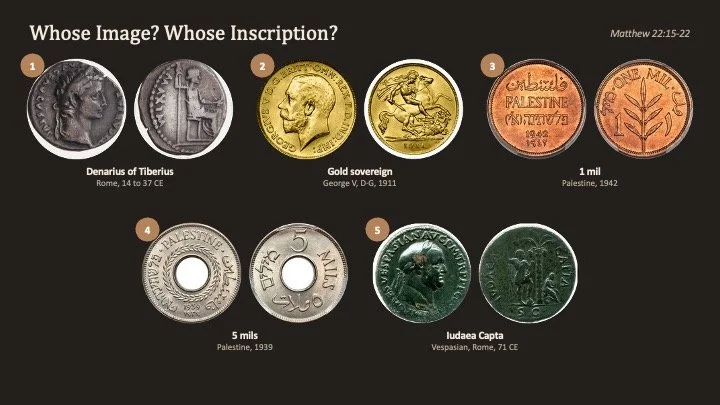
On the left you can see what they held up (#1): the head of Tiberius, crowned with laurel, and around it the words ‘Tiberius Caesar Augustus, son of the divine Augustus.’ On the right, a woman seated on a throne, with the title ‘high priest’ (MAXIM) beside her. A small piece of silver claiming heaven for Caesar.
Then comes the question at the heart of our passage: “Whose head is this, and whose title?” the Greek words are eikōn, image, and epigraphē, inscription. Whose image? Whose inscription?
Empires have always reached for heaven to sign their money.
Look at the second coin. On the left, King George V, and around him the letters D-G, Dei Gratia, by the grace of God. On the right, Saint George slaying the dragon. This gold coin was legal tender in Palestine.
Today, the coins in our own pockets carry his great-grandson, King Charles III, with the same two letters: DG, by the grace of God. South of the border, American bills declare, “In God We Trust,” words added to their paper money in the 1950s, as the nation set itself against what it called godless communism.
A roman emperor, a British King, an American republic, and a Canadian Crown. Each, in its way, writes God’s name beside its own. Jesus’ question asks us to notice when a coin borrows God’s name, and to ask whose claim it is really making.
A Century of Coins
I want to ask Jesus’ question of the coins of Palestine, my land, over the last hundred years.
Before 1917, the people of Palestine paid in Ottoman piastres, the qirsh (قرش), marked with the sultan’s calligraphic signature and struck in Constantinople. Then the British army came from Egypt, and for ten years people paid in Egyptian pounds, the money of the army that had conquered them.
In 1927, the British created the Palestinian pounds, divided into a thousand mils. It comes in 1, 2, 5,10, 20, 50 and 100 in bronze, nickel, and silver. It was struck at the Royal Mint in London, and its value was guaranteed by sterling held in London. There is no king’s face. The British left off the portrait, knowing that Muslims and Jews alike would object. What remains is the inscription (on the slide, the left side of 3 and 4): Palestine, in English, فلسطين (Filastin), in Arabic. And in Hebrew, פלשתינה (Palestina), followed by two small letters, א״י, Eretz Yisrael, Land of Israel. Palestinian leaders protested those two letters, because they carried the Balfour promise into every pocket in the country. The empire removed the image and kept the claim in the inscription.
The 5 mil coin has a hole in the middle, like coins across the British Empire, from West and East Africa to Fiji. During the second World War, its metal was changed to bronze so that the nickel could go to the war effort. Even the small change in a Palestinian pocket bent to the needs of empire. On the slide item #4, you can see the hole at the centre of both sides. Around it, on the left, the name of the land in a wreath of olive leaves; on the right, the value, five mils. Where other coins of the Empire placed the crown and the king’s name, this one places the land’s name.
I have some of these coins from my father’s collection. In 1948 they stopped being money. The Mandate ended. In Israel came the lira, and later the shekel. In the West Bank, the Jordanian dinar. In Gaza, the Egyptian pound. After 1967, the shekel nearly everywhere.
The sultan’s signature. The Egyptian pound. The London mil. The lira, the dinar, the shekel. The inscription changes. The empire changes. The face on the coin changes. What does not change is life under empire.
Today: Three currencies and no coin of our own
Today, Palestinians in the West Bank live with three currencies at once. Wages, groceries and taxes run on the Israeli shekels.[1] Land, savings, and large purchases are often in Jordanian dinars; almost a quarter of bank deposits in the West Bank are still held in dinars, and some towns still send their bills in them.[2] The US dollar serves for trade and for money sent home by family abroad.[3] Under the Paris protocol of 1994, part of the Oslo process, Palestinians were given no currency of their own; the shekel, the dinar, and the dollar were simply allowed to circulate.[4]
A shekel is worth about 33 American cents; three shekels make roughly one US dollar. A Jordanian dinar is worth about a 1 dollar and 40 cents. I give you the values in US dollars for a reason. Three currencies circulate in the West Bank. Yet the dinar’s value is fixed to the dollar, the shekel is measured against the dollar, and savings are kept in dollars. And the power that controls the flow of shekels receives billions of dollars in military aid from Washington every year.
In Jesus’ day, people paid for bread with the bronze coin of Herod, and behind Herod stood the silver of Rome. If you want to who the empire is, follow the coin that holds the value. Among the coins in a Palestinian pocket, there is one maximus, and it is the one that says, “In God We Trust.”
And even the shekel does not move freely. Israel allows Palestinian banks to return only 18 billion shekels in cash each year, while around 30 billion flow in.[5] The surplus piles up in bank vaults with nowhere to go. The governor of Palestinian Monetary Authority told a reporter this summer that he had more than eight billion shekels sitting in the basement of his own building. Banks have had to limit deposits.[6] This is an old wound: the International Monetary Fund described the same buildup of trapped shekels four years ago, noting it had gone on for more than a decade.[7] This year, the two Israeli banks that connect Palestinian banks to the outside world announced they would end those services.[8] Those links carry 51 billion shekels a year and nearly all Palestinian trade,[9] including payments for fuel, electricity, water, and food.[10] The deadline has now been pushed to the end of December, and the lifeline is renewed a few months at a time. Imagine your bank telling you it cannot accept your paycheque because the vault is full, and that next month, it may not be able to pay for your electricity at all.
And then there is Gaza.
No new cash has entered Gaza since October 2023.[11] In the midst of genocide, the places that hold a people’s money have been destroyed. The World Bank found that nine of every 10 bank branches in Gaza lie in ruins, and of ninety-four cash machines, three still worked.[12] People slept in the street to hold their place in line, and one man waited ten days to collect a single month’s pension.[13] No new money has been allowed in. The same notes have passed through countless hands for three years. They are torn, faded, taped together and shopkeepers refuse them.[14] So, a new trade has appeared: people who repair banknotes, charging 3-10 shekels to mend a single note.[15] Even the ten-shekel coin is often refused, worth almost nothing amid soaring prices.[16] Small change has nearly vanished. The large 200-shekel note now makes up most of the cash left in Gaza, so a woman holding one may be unable to buy a single loaf of bread because no one can make change.[17]
Many people have no working bank and no working machines. Those who have money in an account must go to a broker, who takes a commission to turn a digital balance into paper.[18] Those commissions have reached 40%,[19] and at times more.[20] The Palestinian Monetary Authority tried to help by launching a digital payment system, and half a million people signed up, but it faltered because merchants insisted on cash.[21] Money sent from abroad loses a portion on the way in, and then more again when it is withdrawn.[22] People in Gaza now say it plainly: cash has become a commodity.[23] Families lose nearly half of their own money for the right to spend it. (think about that)
Exposing Complicity
Notice where Jesus’ question lands. Those who asked “is it lawful?” were already carrying Caesar’s coin, inside the Temple. Jesus did not need to answer them. He only needs to ask them to open their hands.
So I ask us to open ours. Our money is quieter than a denarius. It lives in accounts, pensions, investments, and taxes. It moves with a tap. And it is not neutral. It flows into budgets, portfolios, and contracts, some of which sustain the very systems that leave a mother in Deir al-Balah paying 40% for her own money. Jesus’ question is gentle and relentless: show me what you are carrying. Whose inscription is on it?
The Image of God and the Claim of God
Then Jesus says, “Give therefore to the emperor the things that are the emperor’s, and to God the things that are God’s.”
The coin bears Caesar’s image, so it can go back to Caesar. But every person standing in that Temple court bore another image. The same word, eikōn, appears in Genesis: God created humankind in God’s image. Caesar can have his silver. He cannot have the people.
And the land? Scripture is clear. “The earth is the Lord’s and all that is in it.” (Psalm 24:1) “the land shall not be sold in perpetuity, for the land is mine.” (Leviticus 25:23) In Arabic, the land ard (الارض), is feminine. She is mother, holding her children. Empires have inscribed their name on her for a century and more. The sultan’s signature, the London mil, the shekel. None of these inscriptions makes the land theirs.
Every child in Gaza carries God’s image. Every family in Nablus counting shekels that the bank cannot accept carries God’s image. Every person on our own streets, on these unceded lands, carries God’s image. That image is the inscription that no empire can erase.
A word for life under empire
Mattew wrote for people who lived after the destruction of Jerusalem. Rome had taken the half-shekel they once gave for God’s house and sent it to the temple of Jupiter. They paid it because they had to. Look at the last coin, number 5, on the left, the emperor Vespasian. On the right, a palm tree, and beneath it a captive with their hands bound, and a woman sitting on the ground in mourning. Around them the words Iudaea Capta, Judea captured. This was the coin in the hands of Matthew’s first hearers. The land itself, pictured as a grieving mother.
Palestinians know this freedom. It is our sumud (صمود), steadfastness. Paying with another’s money, without surrendering to its claim. Mending a torn banknote so a neighbour can buy bread. Opening a shop when there is no change to give, because the community still needs to eat. Remaining on the land. This is a refusal to let any inscription, however many times it changes, decide who we are and whose we are. Palestinians know this way of living.
So, when you tap your card this week, I invite you to pause for a moment and ask Jesus’ question. Whose image? Whose inscription? And then ask the second question, the one that matters more: what belongs to God?
The answer is the land. The answer is the people. The answer is every child in Gaza, every family in the west Bank, every neighbour here.
Give the emperor his coins. The emperors change. Their coins change. And the people of the land, bearing the image of God, remain.
Further Reading: Voices from Gaza
These two essays come from We Are Not Numbers, a project that pairs young writers in Gaza with mentors to tell their own stories. Both are by Shahed AbuAlShaikh, and both describe what it means to live when your money is no longer yours to spend.
“Losing Our Money to Usurers” (April 21, 2025)
When the war closed the banks, the only way for Shahed’s father to turn his monthly salary into cash was to sell it to traders at a steep discount. At first he refused, because his faith forbids usury. Rising prices and repeated displacement left him no choice, and over sixteen months the traders took more than ten thousand shekels from a family that sometimes went hungry.
wearenotnumbers.org/losing-our-money-to-usurers
“Advanced Banking, Primitive Living” (December 3, 2025)
After the October 2025 ceasefire, mobile payment apps spread quickly across Gaza, even as families still lived in tents, cooked on firewood, and washed clothes by hand. Shahed describes buying her first jar of coffee in ten months through an app, then brewing it over a makeshift fire in the rain: “Our phones have become a tool for survival, the apps a lifeline.”
wearenotnumbers.org/advanced-banking-primitive-living
[1] Rafah Hamad, THE ABSENCE OF A PALESTINIAN NATIONAL CURRENCY: CONSEQUENCES AND SOME CHALLENGES, 2020, https://usiena-air.unisi.it/handle/11365/1113209.
[2] Avia Liberman, “Currency Policy Options for the Palestinian Economy,” Atlantic Council, August 21, 2026, https://www.atlanticcouncil.org/in-depth-research-reports/issue-brief/currency-policy-options-for-the-palestinian-economy/.
[3] “Conference Paper on the Palestinian Multi-Currency System, Proceedings,” (University of Ruse), 2025, https://conf.uni-ruse.bg/bg/docs/cp25/5.1/5.1-17.pdf.
[4] Avia Liberman, “Currency Policy Options for the Palestinian Economy,” Atlantic Council, August 21, 2026, https://www.atlanticcouncil.org/in-depth-research-reports/issue-brief/currency-policy-options-for-the-palestinian-economy/.
[5] “In the Israeli-Occupied West Bank, Too Much Cash Is Breaking the Economy,” accessed October 14, 2026, https://english.aawsat.com/node/5297974.
[6] Palestinians Have No Place to Put Their Money. Officials Warn a Breakdown Is Looming, directed by Emily Feng, NPR, August 13, 2026, 3:56, https://www.npr.org/2026/08/13/nx-s1-5913064-e1/palestinians-have-no-place-to-put-their-money-officials-warn-a-breakdown-is-looming.
[7] “West Bank and Gaza: Selected Issues,” IMF, accessed October 14, 2026, https://www.imf.org/en/publications/cr/issues/2022/09/15/west-bank-and-gaza-selected-issues-523402.
[8] “Concerns of Palestinian Economic Crisis Grow as Israeli Banks Prepare to Cut Ties,” Ground News, July 24, 2026, https://ground.news/article/israeli-banks-want-to-sever-ties-with-palestinian-banks-with-drastic-consequences-for-the-economy-in-the-occupied-west-bank.
[9] Ground News, “Concerns of Palestinian Economic Crisis Grow as Israeli Banks Prepare to Cut Ties.”
[10] “Palestinian Authority Raises Alarm as Israeli Banks Plan to Cut Ties,” L’Orient Today, July 23, 2026, https://today.lorientlejour.com/article/1542288/palestinian-authority-raises-alarm-as-israeli-banks-plan-to-cut-ties.html.
[11] Rosa Rahimi and Ghada Abdulfattah, “‘Cash Became a Commodity’: The Liquidity Crisis Compounding Suffering in Gaza,” The New Humanitarian, April 17, 2025, https://www.thenewhumanitarian.org/news-feature/2025/04/17/cash-became-commodity-liquidity-crisis-compounding-suffering-gaza.
[12] Sentinel Digital Desk, “‘Israel Destroyed 93 per Cent of Bank Branches in Gaza’ Says World Bank,” The Sentinel - of This Land, for Its People, December 19, 2024, https://www.sentinelassam.com/more-news/international/israel-destroyed-93-per-cent-of-bank-branches-in-gaza-says-world-bank.
[13] “4 ATMs, 2 Million People: Cash Crunch Compounds Gaza’s Wartime Woes - CSMonitor.Com,” accessed October 14, 2026, https://www.csmonitor.com/layout/set/amphtml/World/Middle-East/2024/0703/gaza-war-palestinians-cash-atms. cathy, “Losing Our Money to Usurers,” We Are Not Numbers, April 21, 2025, https://wearenotnumbers.org/losing-our-money-to-usurers/.
[14] Rosa Rahimi and Ghada Abdulfattah, “‘Cash Became a Commodity.’”
[15] “Gaza Cash Crisis Paralyses Economy as Families Forced to Sell Belongings,” The Siasat Daily, July 11, 2025, https://www.siasat.com/gaza-cash-crisis-paralyses-economy-as-families-forced-to-sell-belongings-3244711/.
[16] “ANOTHER GAZA BANKNOTE REPAIRMAN,” accessed October 14, 2026, https://coinbooks.org/v28/esylum_v28n52a25.html.
[17] Rosa Rahimi and Ghada Abdulfattah, “‘Cash Became a Commodity.’”
[18] Ground News, “Concerns of Palestinian Economic Crisis Grow as Israeli Banks Prepare to Cut Ties.”
[19] Orient Today, “Palestinian Authority Raises Alarm as Israeli Banks Plan to Cut Ties.”
[20] The Siasat Daily, “Gaza Cash Crisis Paralyses Economy as Families Forced to Sell Belongings.”
[21] Orient Today, “Palestinian Authority Raises Alarm as Israeli Banks Plan to Cut Ties.”
[22] “ANOTHER GAZA BANKNOTE REPAIRMAN.”
[23] “ANOTHER GAZA BANKNOTE REPAIRMAN.”