Sacred Bodies, Broken Systems: Gender and Healing in the Genealogies
Scripture Readings: Matthew 1: 1-16 / Matthew 1:18-25
Now the birth of Jesus Christ took place in this way. When his mother Mary had been betrothed to Joseph, before they came together she was found to be with child of the Holy Spirit; and her husband Joseph, being a just man and unwilling to put her to shame, resolved to divorce her quietly. But as he considered this, behold, an angel of the Lord appeared to him in a dream, saying, “Joseph, son of David, do not fear to take Mary your wife, for that which is conceived in her is of the Holy Spirit; she will bear a son, and you shall call his name Jesus, for he will save his people from their sins.” All this took place to fulfil what the Lord had spoken by the prophet: “Behold, a virgin shall conceive and bear a son, and his name shall be called Emman′u-el” (which means, God with us). When Joseph woke from sleep, he did as the angel of the Lord commanded him; he took his wife, but knew her not until she had borne a son; and he called his name Jesus.
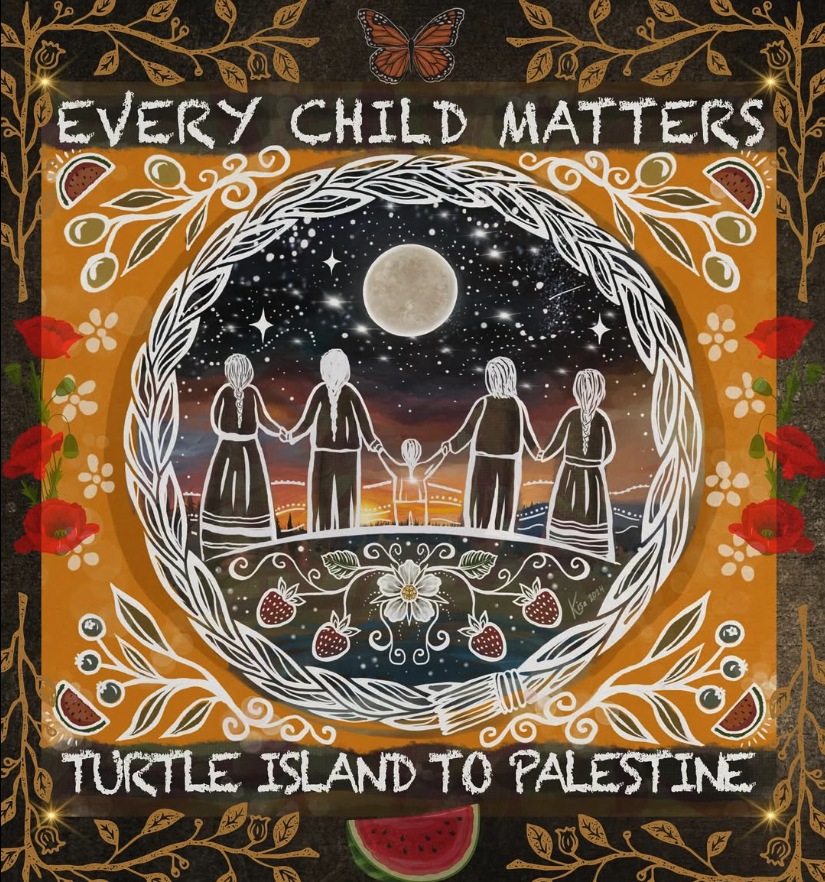
Artwork from Kisa Maclsaac (Used with Permission)
In a moment of profound vulnerability, a father in Gaza cradles a child not his own. His hands, weathered by survival, hold a fragile hope against a landscape of destruction. This image echoes an ancient narrative of protection, of masculinity reimagined.
I used to read Matthew's genealogy, 1:1-16, as a historical record. Now, I see it differently—as a complex tapestry woven with threads of care, protection, and resistance against systems of power. The genocide has transformed how I encounter these ancient texts.
Consider Hazem al-Naizi (حازم النعيزي), director of the Mabarat Al-Rahma (مبرة الرحمة) orphanage in Gaza. When bombs fell near the orphanage in late October 2023, he faced an impossible choice—abandon the children or risk death. "Where will I leave these children, on the street?" he asked.[1] With no options, he evacuated forty children—eight of them infants and many with disabilities—moving them through a war zone. For months, he carried those who couldn't walk, including eight-year-old Ayas, (أياس), a boy with cerebral palsy who couldn't eat solid food.
Through multiple displacements, Hazem carried Ayas in his arms while his own seven-year-old son, Yamen, walked beside him. Despite his efforts, Ayas died in February 2024 on the way to a hospital in Rafah. "Ayas is just a child among thousands of children who suffer here in Gaza," Hazem wrote.[2] Yet the day of the burial, Hazem received news that new orphaned infants needed care. Now, nearly two years later, he continues this work, caring for new orphans including a baby girl with Down syndrome named Yafa. "We hope to do our duty by caring for them," he wrote in mid-2024, "providing them with a decent life and a sound upbringing, and compensating them for the family they lost."[3]
As the crisis expanded, others have stepped into similar roles. Teacher Mahmoud Kallakh (محمود كلاخ) established what is now called an "orphanage city"—the Al-Baraka camps in the Al-Mawasi area west of Khan Younis. These four camps now house approximately 2,500 orphaned children from 400 families who have lost their breadwinners.[4] The scale is staggering—nearly 40,000 children in Gaza (almost the size of the population of West Vancouver) have lost one or both parents, with about 17,000 (3-times the capacity of Rogers Arena) having lost both parents since October 2023, in what officials describe as "the largest orphan crisis in modern history."[5]
These stories reveal something profound about care and gender. In Palestinian traditional society, extended families typically cared for orphaned children. But with entire family networks devastated, new forms of community have emerged. "We are like siblings here," says Nada, a young resident at Al-Baraka. "All mothers are like our mothers, and all children are our siblings. We love each other here very much."[6]
This transformation reflects what one young Gazan writer calls a new masculinity emerging from the ruins. In a powerful essay for +972 Magazine, Abdallah Aljazzar observes: 'Men who weep in public, who change diapers in tents, who share grief with strangers—these men are forging a new kind of masculinity, one that rejects domination and embraces care.' This embodies the rahma (رحمة) that flows from the divine womb, the same rahma in Hazem's orphanage name, Mabarat Al-Rahma—a house of mercy. In both Arabic and Hebrew, words for mercy derive from the womb—rechem in Hebrew, rahm in Arabic—suggesting that true strength flows from life-giving, nurturing love rather than dominating power. Palestinian fathers are discovering that 'being present' matters more than traditional protection, that 'staying human' under impossible circumstances is itself a form of divine resistance. In this space of shared vulnerability, traditional gender roles dissolve—men become nurturers, women become providers, children become caregivers to younger siblings.
In this space of shared vulnerability, traditional gender roles dissolve—men become nurturers, women become providers, children become caregivers to younger siblings.
Matthew's genealogy in 1:1-16 traces Jesus’ lineage through forty-two generations, but five women appear in this otherwise male-dominant list: Tamar, Rahab, Ruth, Bathsheba (identified as the ‘wife of Uriah’), and Mary. These inclusions point to similar disruptions of expected roles. Consider Boaz, a pivotal figure whose story reveals something profound. Encountering Ruth, a Moabite widow, he could have exploited her vulnerability. Instead, he provided protection, economic support and legal care that transcended minimal obligation.
What strikes me now is how the genocide has revealed unexpected gender reversals, both in Gaza and in scripture. Walter Bruggemann’s citation of Wendell Berry’s observation that ‘any society is likely to treat its land in the same way that it treats its women’ provides theological framework for understanding this connection. Drawing from his parallel, I see how Mary’s story illuminates Gaza’s reality: In Matthew's narrative, Mary's body becomes the primary theological site—a space where divine purpose and human vulnerability collide in profound ways, where divine peace takes flesh amid imperial Roman violence. Her body, like Gaza itself, becomes contested territory where competing claims of authority play out. The text presents Mary as simultaneously powerful and vulnerable—carrying divine presence while facing social stigma and potential violence.
The complex negotiation of bodily autonomy in Mary's story resonates differently when read alongside Palestinian mothers giving birth in bombed hospitals, or women like Nada's mother in Al-Baraka camp who must protect their children while grieving unimaginable losses. Mary's explicit consent is curiously absent in Matthew's account—we don't hear her voice as we do in Luke. This silence takes on new meaning when we consider the voicelessness of Gaza's mothers whose decisions about their children's safety are constrained by displacement, dispossession and violence. As Palestinian feminist analysis recognizes, settler colonialism targets both land and women's bodies simultaneously—with women being "doubly affected by structural and intra-communal and interpersonal violence" under colonial occupation, while simultaneously being severed from the land-based practices that historically provided them "social and economic independence."[7]
Yet paradoxically, Mary emerges as a vessel through which divine purpose is enacted. Her "yes" (implied in Matthew, explicit in Luke) becomes a defiant act—a political and theological resistance against expected social scripts, a claiming of space in a violently restrictive social system. Palestinian mothers today face similar paradoxes, giving birth amid destruction, protecting children in impossible conditions.
Joseph's dilemma also speaks differently now. In Matthew 1:20, when Joseph learns of Mary’s pregnancy, the Greek word ἐνθυμηθέντος (enthomethentos) traditionally gets translated as ‘considered’ or ‘resolved.’ However, Kenneth Bailey, a biblical scholar who spent decades in the Middle East, argues this word has an additional meaning: 'became angry/upset/fumed over this matter.'[8] This suggests an emotionally charged moral wrestling within a system designed to control women's bodies. The name Joseph in Hebrew itself means "God will add" or "God will increase"—and both biblical Josephs embody this meaning through radical acts of addition to their families. The first Joseph, son of Jacob, preserved life during famine and became the instrument through which God added survival to the covenant people during their time in Egypt. This second Joseph adds a child not biologically his own to his lineage, increasing his family through divine encounter rather than natural generation.
Both Josephs are sons of promise within the Abrahamic lineage, and both receive divine revelation through dreams that call them to protect vulnerable life. The first Joseph's dreams led him to preserve his family and Egypt from famine; this Joseph's dreams lead him to preserve Mary and the child from social death and Herod's violence. Both step beyond conventional expectations—the first forgiving his brothers who sold him into slavery, the second accepting a pregnancy that could destroy his reputation.
The phrase ‘divorce her quietly’ translates the Greek λάθρᾳ, (Lathra), commonly rendered as ‘privately’ or ‘secretly’ in Matthew 1:19, an act of potential mercy in a society where women faced stoning for perceived sexual transgressions. This rare term appears only four times in the New Testament, with its other significant appearance in Matthew 2:7, where King Herod "secretly" calls the magi—a parallel that suggests both protective and sinister dimensions of hidden actions.[9]
But the angel appears with a more transformative alternative—claim this child as your own, step into a care that transcends biological obligation. As Omar Harami, director of Sabeel, reflects on this passage in the 2025 Red Letter Christians Advent Resource: "Matthew calls Joseph 'righteous' not because he obeyed the law, but precisely because he chose not to. According to the law of his time, Mary's pregnancy outside of marriage would have marked her for shame, even death. The law demanded punishment; society expected dishonor. Yet Joseph listened to a deeper voice, the voice of mercy. His righteousness lay in protecting life, not in enforcing rules."[10]
Harami continues: "History reminds us that laws have not always protected life or dignity. Slavery was once legal. Apartheid in South Africa was legal. Segregation in the United States was legal... Even today, the persecution of Christians in many parts of the world, the displacement of our Palestinian communities, and the denial of basic human rights are justified by legal systems.” Similarly, I will add that in Canada, the Indian Act systematically dispossessed Indigenous peoples of their land, children and cultural identity — still legally sanctioned today, though its mechanisms have evolved from the overtly assimilative policies of the past century to more subtle forms of ongoing discrimination.[11] “But,” Harami continues, “legality does not make justice. A law can enslave, silence, or oppress. Joseph shows us that righteousness does not rest in obedience to laws, but in the courage to protect the vulnerable."
In this moment, Joseph resembles Hazem and Mahmoud and countless others in Gaza who now care for children not their own. Some scholars even question Joseph's historical existence,[12] suggesting Matthew created this figure to address early Christian concerns about Jesus's legitimacy—which would make his textual silence even more profound. Joseph never speaks a single word throughout the Gospel, making him one of scripture's most enigmatic figures. The narrative is not about a heroic rescue of a woman in distress. Rather, it's about how crisis reveals a deeper truth: that authentic care disrupts expected power dynamics and creates new genealogies of belonging. Perhaps Joseph understood that actions speak louder than words, or maybe he just knew when to stay quiet and act with love. Faithful either way.
The child that Joseph would protect bears the Hebrew name יֵשׁוּעַ —Jesus—which derives from the same Hebrew root as Joshua, יְהוֹשֻׁעַ. Both names derive from the same Hebrew root meaning "God saves." In Arabic, their names are even closer: يسوع (Yasū') for Jesus and يشوع (Yūsha') for Joshua. Yet where Joshua saved through conquest and elimination of Canaanites, this Jesus saves through inclusion of their descendants. Where Joshua the conqueror commanded the Israelites to destroy the inhabitants of the land, Jesus the saviour is born among those very people, protected by the creation conquest sought to dominate.
Both bear names meaning "God saves"—but embody profoundly different understanding of salvation. The first Joshua saves through military victory and territorial possession; this Joshua saves through vulnerable incarnation and transformative inclusion.
These ancient stories of divine salvation speak directly to our contemporary moment. Like Mary facing an unplanned pregnancy that could destroy her social standing, like Joseph confronting a situation that challenged every expectation of masculine honor, we too find ourselves carrying something unexpected and transformative—the moral weight of witnessing empire's violence against vulnerable families.
Our Advent Calling
Joseph faced his own impossible pregnancy—a situation that demanded he step beyond social expectations into a new understanding of family, protection, and care. As we saw earlier, Joseph likely "fumed over this matter,"[13] experiencing the natural anger of betrayal and confusion. We who have witnessed from afar carry our own impossible pregnancy: the knowledge of what empire's violence means for families still trapped, still dying.
Like both biblical Josephs—the one who forgave his brothers and saved them from famine, and this one who claimed a child not his own—we felt that initial surge of anger when we first witnessed the images: Hazem carrying eight-year-old Ayas with cerebral palsy through multiple displacements, only to lose him en route to a Rafah hospital; Mahmoud establishing his "orphanage city" for 2,500 children who lost their families; fathers like Hazem faced with impossible questions: "Where will I leave these children, on the street?" But Gaza has become the umbilical cord connecting us all to what we're birthing in our own bodies. Through this cord flows not just the nutrients of outrage and grief, but the life-giving force of moral awakening. One that births something more than emotion—it gestates a deeper understanding of divine justice.
So, what kind of justice are we gestating? The same justice that moved Joseph to claim a child not his own, that moves Palestinian men to carry disabled children through war zones, that calls us to birth new genealogies of belonging. This is Emmanuel — God with us— manifested in the hands that cradle vulnerable life. This Advent, as we wait for peace to be born, may we find the courage to midwife the hope already growing in our midst—beyond the frozen-in-time Bethlehem of our Nativity imagination, but in every act of choosing vulnerable love over violent power. The genealogies of healing are already being written. The question is whether we will add our names to their transformative lineage.
This message was preached @ TGUC Under “Emmanuel in Unexpected Hands: Joseph's Care as Advent Hope”
[1] CNN, "Famine looms in Gaza as war grinds on," January 30, 2024. https://www.cnn.com/2024/01/30/middleeast/famine-looms-in-gaza-israel-war-intl; Rosa Rahimi, "Gaza's Orphans," London Review of Books Blog, July 25, 2024. Hazem al-Naizi's quote about Ayas appears in his correspondence with the author. https://www.lrb.co.uk/blog/2024/july/gaza-s-orphans
[2] Rosa Rahimi, "Gaza's Orphans," London Review of Books Blog, July 25, 2024. https://www.lrb.co.uk/blog/2024/july/gaza-s-orphans; Palestinian Centre for Human Rights (PCHR), "On World Children's Day: Gaza children endure the horrors of genocidal war," November 20, 2024. https://pchrgaza.org/on-world-childrens-day-gaza-children-endure-the-horrors-of-genocidal-war/
[3] Rosa Rahimi, "Gaza's Orphans."
[4] TRT World, "After harrowing losses, Gaza's orphans find respite in Al Baraka camps," September 24, 2024. https://www.trtworld.com/magazine/after-harrowing-losses-gazas-orphans-find-respite-in-al-baraka-camps-18212294
[5] Al Jazeera, "Gaza faces 'largest orphan crisis' in modern history, report says," April 3, 2025. https://www.aljazeera.com/news/2025/4/3/gaza-faces-largest-orphan-crisis-in-modern-history-report-says
[6] UN News, "Orphanage city helps children in Gaza as the war grinds on," October-November 2024. https://news.un.org/en/story/2024/10/1155356
[7] Reuben J. Brown, "Bodies of land: feminism and decolonisation," Architectural Review, March 25, 2024, https://www.architectural-review.com/essays/bodies-of-land. Brown quotes Palestinian political prisoner Khalida Jarrar: "Palestinians exist within a domain of colonial occupation, in which all Palestinians are denied freedom, and whereby women within the Palestinian society are doubly affected by structural and intra-communal and interpersonal violence." The article also notes that Palestinian women "have historically foraged for the bounty of herbs and leafy greens that are an important part of Palestinian cuisine, and which provided them with the means to secure social and economic independence."
[8] Kenneth Bailey explains that this Greek word has two meanings: one means to consider or ponder, while the second meaning, quoting Henry G. Liddell and R. Scott, is "he became angry." Additionally, he notes that the root of the Greek word thymos, which occurs once in Luke 4:28, is used to describe the "wrath" of the congregation in the synagogue when it was about to stone Jesus. Kenneth Bailey, Jesus Through Middle Eastern Eyes: Cultural Studies in the Gospels (Downers Grove: InterVarsity Press, 2008), 45.
[9] The term λάθρᾳ (lathra) meaning "secretly" or "privately" appears in Matthew 1:19, 2:7, John 11:28, and Acts 16:37. Its use in Matthew 2:7 regarding Herod's secret meeting with the magi creates an interesting parallel with Joseph's intended private divorce. Blue Letter Bible, "G2977 - lathra - Strong's Greek Lexicon (KJV)," https://www.blueletterbible.org/lexicon/g2977/kjv/tr/0-1/
[10] Omar Harami, "The Way of Joseph: Righteous Disobedience," Red Letter Christians Advent 2025 Resource. https://redletterchristians.org/advent-2025/#advent-sign-up
[11] Indian Act, R.S.C. 1985, c. I-5. Despite decades of amendments, the Act continues to perpetuate discrimination, particularly through the "second-generation cut-off rule" that denies Indian status to many children and grandchildren of First Nations women. See Pam Palmater, "Reconciliation can't wait another generation," Policy Options, November 21, 2025, https://policyoptions.irpp.org/2025/11/reconciliation-second-generation-cut-off/; Indigenous Foundations, University of British Columbia, "The Indian Act," https://indigenousfoundations.arts.ubc.ca/the_indian_act/
[12] Raymond Brown notes the scholarly debate about Joseph's historicity in The Birth of the Messiah (New York: Doubleday, 1993), 124-125. Similarly, Jane Schaberg in The Illegitimacy of Jesus (San Francisco: Harper & Row, 1987) argues that Matthew's Joseph serves primarily theological rather than historical purposes. These scholars typically argue that Mary's pregnancy was the historical reality Matthew had to address, not Joseph's existence. Jane Schaberg, for instance, suggests the pregnancy resulted from sexual violence, and Matthew created Joseph as a literary device to provide theological legitimacy rather than social protection. Raymond Brown argues that Matthew's concern was theological genealogy, not historical biography.
[13] Kenneth Bailey, Jesus Through Middle Eastern Eyes, 46.