A Sermon on John 11:1–45 given at Trinity Grace United Church on March 22, 2026
There is a sentence in our text that appears twice. Once on Martha's lips in verse 21, and once on Mary's lips in verse 32. The same words, spoken by two different women, at two different moments, to the same person:
"Lord, if you had been here, my brother would not have died."
I know this sentence. Not from seminary. Not from a commentary. I know it from my body. As you know, my father died recently. And when I finally arrived in Nazareth just in time for the funeral my sister said something to me. Not these exact words, but the shape of them. She said she wished Baba had waited. That he had held on just a little longer. Just until I got there.
My experience sheds new light on what Martha was really saying to Jesus. She was not making a theological argument. She was not questioning his power. She was saying: You were not here. You were not here for the last breath, the hand-holding, the closing of the eyes.
The scholars help us with the timeline. Jesus was across the Jordan about a day's journey from Bethany when the messenger arrived. And the text tells us, strangely, that when Jesus heard Lazarus was sick, he stayed where he was for two more days. By the time he arrived, Lazarus had been in the tomb four days. Even if Jesus had left immediately, Lazarus would already have been dead for at least two days by the time he reached Bethany. The delay did not cause the death. Lazarus was likely dying or already dead when the messenger set out.
But that does not take the sting out of Martha's words. Jesus was not late for a miracle. He was late for a goodbye. He was late for the presence that grief demands — the body in the room, the hand on the forehead, the witness who can say: I was there.
I. Who Speaks at the Tomb?
One of the things I have learned as a Palestinian Christian reading the Bible is to always ask: who is speaking, and who has been silenced? Whose voice carries the theological weight of the passage, and whose voice has been edited out?
In John 11, it is Martha who does the theology. Not Peter. Not any of the male disciples. Martha. When Jesus arrives late to Bethany, she does not wait for him to come to her. The text says she went out to meet him while Mary stayed in the house. She walks toward him. And after that fierce, grief-shot opening — if you had been here — she adds something: "But even now I know that whatever you ask of God, God will give you."
Then Jesus says, "I am the resurrection and the life." And he asks her: "Do you believe this?"
And Martha says: "Yes, Lord. I believe that you are the Messiah, the Son of God, the one coming into the world."
Friends, listen to what just happened. New Testament scholar Sandra Schneiders makes a critical observation about our passage. I recommend her book Written That You May Believe: Encountering Jesus in the Fourth Gospel (2003) to anyone who wants to go deeper into John. Martha's confession comes before the raising of Lazarus. Not after. She does not confess because she has seen a miracle. She confesses in the shadow of the tomb, with her brother's body decomposing behind a stone. Her faith does not depend on proof. It is spoken from inside grief.
And this confession is the same confession placed on Peter's lips in all three Synoptic Gospels. At Caesarea Philippi, it is Peter who says, "You are the Messiah" (Mark 8:29; Matthew 16:15–17; Luke 9:20). But in John, this confession belongs to Martha. At a tomb. In Bethany. A grieving woman, in a village under Roman occupation. And she said it not because she was blessed by the Father in heaven, as Jesus tells Peter in Matthew, but because she chose to believe when every piece of evidence around her, the four days, the stench, the sealed stone, said there was no reason to.
And this matters, because John's Gospel has what scholars call a "high Christology." John presents Jesus as the pre-existent Word made flesh, the divine "I AM" who existed before Abraham and who is one with the Father. So when Martha confesses Jesus as Messiah and Son of God in this Gospel, she is recognizing the incarnate divine presence standing in front of her at her brother's grave. And John places this recognition, the highest Christological confession in his Gospel, on the lips of a woman in mourning.
Schneiders writes that three of Jesus' most important self-revelations in John are given to women: his identity as the "I AM" and Messiah to the Samaritan woman at the well (John 4:25–26), his identity as the resurrection and the life to Martha at the tomb (John 11:25–27), and the completion of his glorification to Mary Magdalene in the garden (John 20:16–18). The highest Christological statements in the Fourth Gospel are entrusted to women who cross the boundaries of ethnicity, respectability, and religious belonging. John's Jesus does not reserve his deepest self-revelation for the inner circle. He gives it to the margins.
The textual scholar Elizabeth Schrader Polczer has shown that in the oldest manuscripts of John's Gospel, the name Martha shows signs of scribal alteration, suggesting she may have been added later to prevent Mary, possibly Mary Magdalene, from speaking that central confession. Her research was published in the Harvard Theological Review (2017). This is still debated. But the pattern is worth sitting with: later editors took one authoritative woman and split her into two lesser figures. They redistributed her theological voice. They made sure the confession did not carry the weight it was meant to carry.
As a Palestinian, I recognize this operation. It is what empires have always done. They fragment the subject. They separate the insider from the outsider, the "good" minority from the "dangerous" one, the Christian from the Muslim, the diaspora from those under occupation. The pattern Schrader identifies in the manuscript tradition mirrors the strategies of occupation: splitting communities, redistributing agency, ensuring no single testimony carries its full weight.
And notice one more thing. The Greek word used for Martha's activity in both Luke 10:40 and John 12:2 is diakonia. The feminist scholar Elisabeth Schüssler Fiorenza has shown that this word was already a technical term for ecclesial leadership when Luke was writing. It encompassed preaching, presiding at table, and pastoral care. But when a woman does it, translators call it "service" as in "serving dinner." When a man does it, the same word is translated "deacon" or "ministry." The very same word. The domestication happens in translation, not in the text.
II. Why Raise Someone Who Will Die Again?
Now let me turn to the miracle itself. Because there is a question sitting underneath this story that I never asked before: if Martha has already confessed her faith: if the theological climax has already happened, before the stone is rolled away, then why raise Lazarus at all? He is going to die again. Martha already believes. So what is the miracle for?
Lazarus was not raised into an immortal body. He was brought back into his mortal flesh, the same flesh that was already decomposing. He came out of the tomb still wrapped in burial cloths. He would grow old again. He would get sick again. He would die again. John's audience would have understood this.
So what was the point? Understanding the four days might help. In Jewish tradition of the time, the soul was believed to linger near the body for three days after death, hoping to return. By the fourth day, when decomposition was visibly underway, the soul departed for good. Martha's objection at the tomb — "Lord, by now there will be a stench" — is not queasiness. It is the declaration of a boundary. She is saying: This is finished. The biology is irreversible. The verdict is final.
And Jesus crosses that boundary.
The raising of Lazarus is the seventh and final sign in John's Gospel. It is not a solution to death. Lazarus was not exempted from death; he was interrupted from it. The sign is this: the verdict of death — "it is over, it is too late, the stench proves it" — is never God's last word. The world pronounces things dead — people, communities, homelands, languages, ways of life — and God says: Not yet. Come out.
I think of Gaza as I say this. On Saturday, a sandstorm tore through Gaza — the worst in more than five years — destroying the makeshift shelters that displaced families were living in, burying tents in dust, leaving people with respiratory illness exposed and choking with no hospitals to receive them. The next day, Sunday, Israeli airstrikes killed twelve Palestinians. One strike hit a house in the Nuseirat refugee camp, killing a couple and their two boys. A pregnant woman was among the dead. Another strike killed eight police officers. Fourteen more were wounded. The bodies were taken to al-Aqsa Martyrs Hospital. All of this during a ceasefire under which more than 650 Palestinians have already been killed. And since Israel launched its war on Iran on March 1, all border crossings into Gaza have been closed, including the Rafah crossing that had only just reopened weeks earlier. Medicine, fuel, food — choked off again. A people sealed inside their own land, with the dust and the bombs and the borders all saying the same thing: It is over. The verdict is final.
And I hear Jesus at the tomb saying: Not yet.
The empires may be done with Gaza. The mainstream media may have moved on. The world may have pronounced its verdict — sealed the stone, declared the stench. But God is not done with Gaza. God has never let the empire's verdict stand. The one who called Lazarus out of a tomb after four days has not gone silent in the face of rubble and sealed borders. Come out is still being spoken over every place the powers have declared dead.
But here is what John also wants us to see: the act that gives life is the act that sets death in motion for Jesus. The very next thing that happens in John's narrative is the religious authorities deciding that Jesus must die. Caiaphas says, with terrible irony, that it is better for one man to die for the people. The miracle that calls Lazarus out of the tomb is the miracle that leads Jesus toward his own.
Resurrection and crucifixion. They are not opposites in this Gospel. They are bound together. The one who gives life does so at the cost of his own. And Lazarus, who has been given back his breath, will spend the rest of his life carrying the knowledge of the tomb inside him.
III. From Bethany to Larnaca to Bethany
What happens to Lazarus after this? The Gospel gives us only one more glimpse: he is at dinner in Bethany in John 12, reclining at table, and the chief priests are plotting to kill him too, because his living body is causing too many people to believe.
But the Orthodox tradition carries the story further, and it is a story every displaced person will recognize.
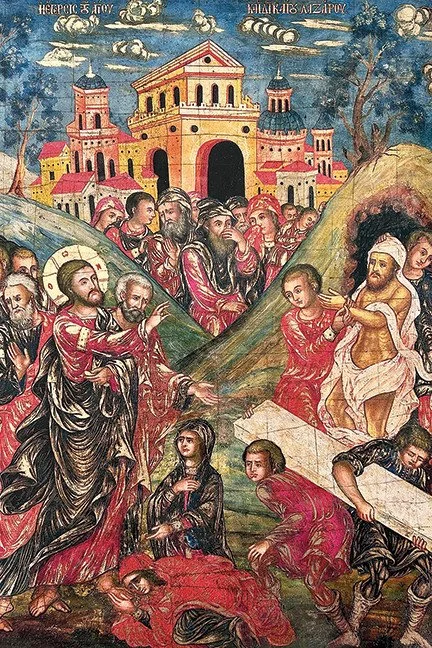
On the screen behind me is an icon of the Raising of Saint Lazarus that I bought the last time I was at the Church of Saint Lazarus in Larnaca. Look at it. In the iconographic tradition, Jesus stands at the left, his hand extended in command. Lazarus stands upright in the mouth of the tomb, still wrapped in burial cloths, his face visible but his body bound. And around them — always — are the witnesses. The community that gathers at the site of death. This icon has travelled with me from Larnaca to Vancouver. A displaced image of a displaced man, carried by a displaced woman.
According to Greek Orthodox tradition, after the events of John 11 and 12, the chief priests made good on their threats. Lazarus was forced to flee Judea. Like the early Christians scattered by the persecution that followed Stephen's martyrdom, Lazarus had to leave Bethany — his home, the place where Jesus had called him by name — to save his life. He went to Cyprus. There, Paul and Barnabas found him and ordained him as the first Bishop of Kition — what is now the city of Larnaca.
I have been to Larnaca a few times. I have stood inside the Church of Saint Lazarus, built in the ninth century over his second tomb. To this day, all the episcopal thrones in Larnaca carry the icon of Saint Lazarus instead of the icon of Christ — a practice unique in the Orthodox world. And every year on Lazarus Saturday, eight days before Easter, his icon is carried in procession through the streets of the city.
Less than a month ago, because of the current US-Israel war on Iran, I had to flee the country by sailing to Cyprus — just as Lazarus fled by sea nearly two thousand years ago. I found myself on that same island, displaced for similar reasons: the violence of empires, the impossibility of staying. And there in Larnaca, across the street from the Church of Saint Lazarus, is a restaurant that belongs to my brother — named after my father Eliya. I sat there, in the shadow of Lazarus's church, with my father's name over the door, and I felt the centuries fold in on themselves. Different powers, different wars — but the same sea, the same island, the same refuge sought by a body that could not stay home.
Think about this. The man who was raised from the dead became a refugee. The one called back to life was pushed out of his homeland by authorities who could not tolerate the testimony his living body represented. His very existence was a threat to those in power. And so Bethany lost Lazarus. And Larnaca received him. And his body — the body that had already died once, the body that carried the memory of the tomb — made that island holy.
There is a tradition recorded in the Synaxarion, the Orthodox saints' calendar, that during his thirty years in Cyprus, Lazarus never smiled. Never laughed. Never joked. Except once. One day, he saw someone stealing a clay pot, and he said: "The clay steals the clay."
What did he mean? A clay pot is made from the earth. And the person stealing it is also made from the earth. Lazarus, who had been inside the grave, who had been held by the soil itself, found it absurd that a creature made of earth would steal a piece of earth, as though any of us could truly own the ground from which we come and to which we will return. The clay steals the clay. It is the laughter of a man who has seen the other side of death and come back knowing that all our possessions, all our borders, all our deeds of ownership are dust claiming dust. If that is not a word about land theft, I do not know what is.
Now let me take you back to Bethany. Because Bethany still exists. Its Arabic name is al-Azariyya — it literally carries Lazarus's name. The village where Jesus wept, where Martha theologized, where Mary's mourning gathered the community — that village is still there, on the eastern slope of the Mount of Olives, less than three kilometres from Jerusalem.
But if you live in al-Azariyya today, you cannot walk those three kilometres to Jerusalem. The separation wall runs between them. Mother Agapia Stephanopoulos, a Russian Orthodox nun who has lived in Bethany from 1996, and ran the Orthodox girls' school there, has testified to this. In a widely viewed interview with Tucker Carlson, she described what daily life looks like in the village where Lazarus was raised: Palestinians, including Christians, face restrictions on movement, land confiscation, and the severing of their communities. "We are closed off in Bethany from going to our convent in Jerusalem because of the wall built on Palestinian land," she said. A Christian home for boys was taken over and cut up to build part of that wall.